|
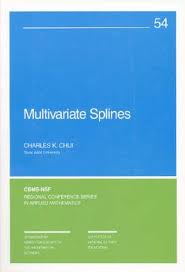
Author(s): Charles K. Chui
title: Multivariate Splines Series: CBMS-NSF, Regional Conference Series in Applied Mathematics Publisher: SIAM Pages: vi+189 Year: 1988 ISBN: 9781611970173 URL: epubs.siam.org/doi/book/10.1137/1.9781611970173 Short description: Bull. BMS: ♠ MSC main category: 65 MSC category: 65D07 |
|
Review:
The ten chapters of this monograph are a compilation of the material presented by the author at a Regional Conference held at Howard University in Washington DC, during August 10-14, 1987.
The theory of univariate splines is well developed and good books are available like for example the ones by Schoenberg (1973) and later by de Boor (1978) and by Schumaker (1981) are among the best known ones. The extension of the classical theory to polynomial splines in more variables is an area of active research during recent years, but this monograph is the first book completely devoted to this subject. The papers on the subject are often of a rather theoretical type, although the subject has a very great potential in applications. Therefore I think it is a good idea of the author to follow an elementary point of view that parallels the theory of univariate splines. Many proofs and details are discarded. For these, the reader should consult the bibliography, which is rather extensive (209 items).
As we said, the theory is developed in parallel with the univariate case, which is reviewed in the first chapter. The definition of splines as the solution of an extremal problem is not included because the multivariate analog of this gives rise to the definition of thin plate splines which are not discussed in this monograph. The basic splines discussed are B-splines, their approximating properties and their computation. Next chapter introduces the so called multivariate box splines. The next two chapters discuss in more detail the bivariate case. For grid partitions consisting of simplices and parallelepipeds, it is more convenient to have barycentric coordinates, rather than cartesian coordinates which gives rise to a Bézier representation of the spline. This is discussed in chapter 5. The property that B-splines have minimal support and have minimal degree $r+1$ in $C^r$ is not easily generalized to the multivariate case. The vertex splines introduced by Chui and Lai are multivariate piecewise polynomials of minimal degree in $C^r$ with support that contains at most one vertex in its interior. In this sense they come somewhat near a multivariate B-spline. These are discussed in chapter 6. The next one is concerned with computational algorithms, more precisely an approximation scheme based on a recurrence relation (useful for graphic display purposes) and an explicit representation (in terms of a Bézier net say) of each polynomial piece. More on quasi-interpolation schemes for discrete data on a uniform grid and on Lagrange interpolation is to be found in the next two chapters while in the last one the highly important problem in computer aided geometric design of surface representation with prescribed shape constraints is discussed in the situation of approximation and interpolation.
This monograph does not give all the results about multivariate splines that were published in the last decade, but it gives a nice survey of a large part and it can be safely advised for a first reading of a relatively new field of mathematics. Applied scientists will be forced to get in contact with this material because of its many potential applications and ``pure'' mathematicians will be attracted by a fascinating and challenging topic with yet many open problems to solve.
Reviewer: A. Bultheel (KU Leuven)
January 23, 2013