|
Author(s): William H. Press, Brian P. Flannery, Saul A. Teukolsky, William T. Vetterling
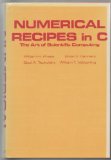
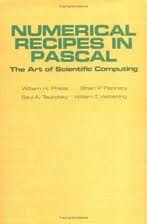
title: Numerical recipes in C. The art of scientific computing Publisher: Cambridge University Press Pages: xxii+735 Year: 1988 ISBN: 9780521354653 Author(s): William H. Press, Brian P. Flannery, Saul A. Teukolsky, William T. Vetterling title: Numerical recipes, example book (C) Publisher: Cambridge University Press Pages: xi+239 Year: 1988 ISBN: 9780521357463 Author(s): William H. Press, Brian P. Flannery, Saul A. Teukolsky, William T. Vetterling title: Numerical recipes in Pascal. The art of scientific computing Publisher: Cambridge University Press Pages: xxii+759 Year: 1989 Author(s): Julian C. Sprott title: Numerical recipes, Routines and examples in Basic Publisher: Cambridge University Press Pages: xi+398 Year: 1989 Author(s): Julian C. Sprott title: Numerical recipes, Routines and examples in Basic V1.0 Publisher: Cambridge University Press Pages: xi+398 + diskette Year: 1991 Short description: Bull. BMS: ♠ MSC main category: MSC category: |
|

Review:
The original version of the well-known and successful Numerical Recipes, the art of scientific programming was a combined Fortran/Pascal version. It is a cookbook on numerical computation. For each topic, it offers a certain amount of general discussion, some analytical mathematics, a discussion of algorithms and --- the most important part --- the actual implementation of these ideas in the form of working computer routines. For some topics with standard mathematical prerequisites, the treatment is tilted towards a more in-depth discussion of the implementation, for other, less standard topics, the discussion is inclined towards the analytic side. The authors want to propagate the idea that a practical method of numerical computation can be efficient and clever and at the same time also clear. They firmly reject the idea that a good routine should be designed by specialists and used as a black box by the others. So they essentially try to open these boxes and let the reader have a look inside.
The book includes all the standard topics of a numerical analysis course: linear equations (chap. 2), interpolation and extrapolation (chap. 9), eigensystems (chap. 11), ordinary differential equations (chap. 15) and an introductory chapter on partial differential equations (chap. 17). Many of them go beyond the standard treatment, e.g., special linear systems (Toeplitz, Vandermonde, ...), rational interpolation and extrapolation, integrals with singularities, Dekker-Brent algorithm for root-finding etc. Also some non-standard topics are included like function and special function evaluation (chap. 5--6), random numbers and Monte Carlo methods (chap. 7), sorting (chap. 8), optimization (chap. 10), Fourier transforms (chap. 12), statistical description and modeling of data (chap. 13--14), two-point boundary value problems (chap. 16).
Now this book has got several successors in other languages. The C version was the first to appear. This is not a surprise because this language is becoming increasingly more important and universal. It is the first serious candidate to replace Fortran for scientific computing. This C version is the first book to review. The previous topics are exactly as in the original Fortran/Pascal version. There are some 200 C routines compiled in it. Many unique features of the C language are used like dynamic memory allocation, modularization, pointer reference to matrices, etc. Not everyone seems to be happy with the choice that is made here to handle matrices, but time will learn if the authors made the right choice or not.
The example book is designed to accompany the reference and text book. Since the routines are functions, not stand-alone programs, they have to be incorporated in some other program. Even if a description is given of how to use the routines, there is no substitute for an actual demonstration program. This is exactly what the example book is for. It may also happen that you want to check your modifications with an example that worked perfectly with the old routine, then again this example book will provide you the examples. It has the same chapters as the mother text has and it demonstrates all the routines included there. Each program is prefaced by a short description of what it does and what routines are tested. This book is to accompany the numerical recipes in C book, without this, it is practically meaningless.
In the original version of the book, the so called Fortran/Pascal version, the routines were designed in the first place as Fortran routines. At the end of the book these Fortran routines were translated into Pascal but inherited the Fortran style which made them look horrible to the real Pascal lovers. The authors have taken this criticism to heart and in 1989 the separate Pascal version appeared with completely re-thought routines in Pascal that used the typical Pascal structures, so that they don't look like translated Fortran anymore. So there are now three versions of the same book, differing only in the computer programs: the Fortran, C and Pascal version. Of course, each one is accompanied with their respective example book and diskettes. The latter can be obtained for IBM/PC or Macintosh.
As for the Basic version, no separate version of the main book is made, but that this is not really necessary since Basic is close enough to Fortran. There is only the Basic version of the example book, of which the bibliopgraphic data are given above. The diskette contains both the Basic versions of the routines from the reference book as well as the routines from the example book. For the other versions, these diskettes are separate.
This project is of invaluable importance for everyone who has to do scientific computation. It brings a complete numerical library to a PC where they were previously only available on mainframes. The correct choice is made among methods from the up to date literature and almost all the important problems are treated, even some non-classical ones. Besides this, the text is most pleasant to read and can be used as a textbook in practical numerical mathematics.
Reviewer: A. Bultheel (KU Leuven)
January 26, 2013