|
Author(s): Michel Marchand
title: Mathématique discrète, outil pour l'informaticien Publisher: De Boeck-Wesmael Pages: 499 Year: 1989 ISBN: 2-8041-4963-3 Author(s): Peter Fletcher, Hughes Hoyle, C. Wayne Patty title: Foundations of discrete mathematics Publisher: PWS-Kent Publishing Company Pages: xiii+781 Year: 1990 ISBN: 978-0-53492-373-0 Short description: Bull. BMS: ♠ MSC main category: MSC category: |
|
Review:
Because discrete mathematics become more and more important, you see new books on the subject appear regularly. You find them in all kinds and at all levels: some are rather applied for example to informatics or graph theory or operational research, others are very theoretical with abstract and difficult theorems and still others concentrate on computational and algorithmic aspects. The present books are of yet another type: they are a basis for introductory courses (somewhat like a first year calculus course) to discrete mathematics. Practically no mathematical prerequisites are required, so it can well be used by other than mathematics students.
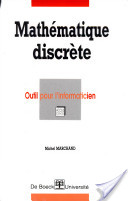
In the first book a selection is made among those topics that are of interest for the computer scientist. This will explain the choice of the following subjects which are treated in successive chapters~: formal logic, basic notions from set theory, recurrence and iteration, Boolean matrices, relations (important for relational databases), functions (with special interest in permutations), ordered sets and lattices including Boolean functions and Boolean algebras, some elements from algebraic structures (groups, monoids). Also the following applications of algebra~: trees, formal languages, finite state machines and error correcting codes are treated extensively.
The presentation of this material has a special attention for the applications. Many algorithms are formulated in a pseudocode. A multitude of examples often highlights some practical situation where the theory can be illustrated. It is not true that the purely theoretical aspects have deliberately been neglected, but the author succeeds in finding always the most practical presentation. The exercises are also important in that respect. They form a considerable part of the material and the solutions, given in an appendix, take about 100 pages, that is 20 % of the book.
The typesetting and physical appearance of the text is very pleasing and makes it easy to read. Thus it forms an excellent book to be used as lecture notes for a first year university course or some equivalent of that. Because of the many different topics treated and the practical solutions given, it can also serve as a reference work. Here lies however a weak point of the book. The thickness of the paper used makes it so thick that it is less manageable (the book is over 4 cm thick). On the other hand, the soft cover realization doesn't give it a robust appearance. It doesn't look like it is up to an intensive use as a handbook during say more than a year. The latter is correlated to the price of the book which is of course a strong point in favor of this volume. par The second book treats basically the same subjects, but a bit less informatics oriented. It gives discrete mathematics, stressing the mathematics, with less interest in algorithms.
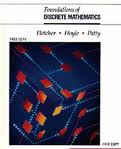
As in the first book, some chapters are really elementary and a mathematics student may want to skip them (logic, sets, functions, induction, elementary matrix theory). The rest of the topics are more or less the same (lattices and error correcting codes are not discussed, but discrete probability is). The last three chapters treat some more advanced topics of Boolean algebra, (expressions and simplification), counting (solving recurrence relations) formal languages and finite state machines. But in this more advanced treatment, just like in the rest of the book, proofs are clearly written out, many figures and examples are given and an overwhelming number of exercises (selected answers are given in an appendix) make the material easy to absorb.
This cheap student edition is literally somewhat easier to handle than the first book, even though there are many more pages, but again I doubt whether the soft cover can resist a heavy duty life.
I don't think there is at present some first year at a European university where the whole course will be given as it is, and this holds for both of these books. Maybe some selection of chapters could be interesting, but used in this way, it is also valuable for students at a postgraduate level without a mathematical education who need some of the topics discussed here. They are also excellent handbooks for selfstudy.
Reviewer: A. Bultheel (KU Leuven)
January 23, 2013