|
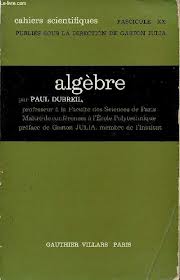
Author(s): Paul Dubreil
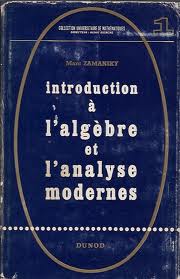
title: Algèbre. Tome 1: Équivalences, opérations, groupes, anneaux, corps (3me ed.) Series: Cahiers Scientifiques, vol XX Publisher: Gauthiers-Villars Pages: xii+467 Year: 1963 Author(s): Paul Dubreil, Marie-Louise Bubreil-Jacotin title: Leçons d'Algèbre moderne Series: Collection Universitaire de Mathématiques, vol 6 Publisher: Dunod Pages: vii+401 Year: 1964 Author(s): Marc Zamansky title: Introduction à l'algèbre et l'analyse modernes (3me ed.) Series: Collection Universitaire de Mathématiques, vol 1 Publisher: Dunod Pages: xviii+435 Year: 1967 Short description: Bull. BMS: ♠ MSC main category: MSC category: |
|
Review:
Of these three books, the first two have an author in common, the last two have the series in common where they appeared. All of them are written in French and are at least partly devoted to basic modern algebra (or a part of it).
It isn't clear for any of the books when their first edition appeared since no information is given by the publishers. However, for the first one, we can make up from a preface by G. Julia that the book was originally written after a series of lectures given by the author in 1941. It is the first volume of a multi-volume book. It treats the subjects already mentioned in the title. The last chapter is not explicitly mentioned there. It discusses algebraic equations, a classical subject is these older books on algebra. Also a rather extensive appendix containing several notes on e.g. the natural numbers, ordinal theory of finite sets, Zorn's axiom and the axiom of choice etc. could be mentioned. It is written in the spirit of the old masters like Hasse, van der Waerden, Birkhoff, Bourbaki. In his preface the author mentions that he will treat more on groups, isomorphisms, linear algebra and Galois theory in subsequent volumes. He also refers to the next volume of the series which is volume XXI~: Leçons sur la théorie des treillis by M.-L. Dubreil-Jacotin.
The second book is co-authored by the latter and the author of the first book. It is more or less written in the same spirit as the first one. There is less on equivalence relations, but it has more on other things. There is a chapter on lattices, it has more group theory (including e.g. the Jordan-Hölder theorem), there is a chapter on vector spaces (which are introduced as groups with operators) and we also find in the chapter on algebraic equations elements from Galois theory. Also the status of the Zorn axiom is raised from a note in an appendix to a separate chapter and is treated rather completely. The book is written for mathematics students, who in their fourth year of the university follow a option in algebra. The authors say that the book is intended to be a manual for these students and therefore it doesn't contain any bibliography, an implication of which the logic isn't clear to me.
The third book [The 2nd edition has been reviewed in this Bulletin, XVI (1964) p. 226.] is also written for university students, but this time not especially for mathematicians. It is oriented also towards engineers or other scientist students who need somewhat more than elementary mathematics. As the title announces, it is partly on algebra and partly on analysis. In the first two chapters, the reader is quickly guided through sets, relations, functions and algebraic structures. The next two chapters discuss linear and multilinear algebra. Via some elements of topology and an explicit study of the real number system, one arrives in chapter 7 at Banach and Hilbert spaces. In subsequent chapters continuity and all the classical theorems in this connection and in connection with topological vector spaces are found. The last chapter is devoted to integration theory. More details can be found in the previously mentioned review of the second edition since this has not drastically changed. A rather exhaustive piece of mathematics, especially for a non mathematician but it is extremely well written. Unfortunately, no exercises are provided.
Reviewer: A. Bultheel (KU Leuven)
January 23, 2013