|
Author(s): W. Blum, M. Niss, I. Huntley (eds.)
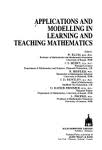
title: Modelling, applications and applied problem solving: Teaching mathematics in a real context Publisher: Ellis Horwood Pages: x+250 Year: 1989 ISBN: 978-0745806334 Author(s): J.S. Blum, R. Biehler, I.D. Huntley, G. Kaiser-Messer, L. Profke title: Applications and modelling in learning and teaching mathematics Publisher: Ellis Horwood Pages: xvi+451 Year: 1989 Author(s): R.R. Clemens title: Mathematical modelling: A case study approach Publisher: Cambridge University Press Pages: viii+166 Year: 1989 ISBN: 0521089557 Short description: Bull. BMS: ♠ MSC main category: MSC category: |
|


Review:
All three of these books are concerned with mathematical modelling and with the incorporation of this discipline into mathematics education.
The first one contains selected papers from two theme groups (organized by W. Blum and H. Niss respectively) at the sixth International Congress of Mathematics Education (ICME-6), held in Budapest, July/August 1988. The special interests of the first group are processes of pure and applied mathematical problem solving and the links between mathematics and the outside world, established by modelling and applications. The other group focussed particularly on the relations between mathematics and the real world and between mathematics and subjects treated in other parallel courses. These main themes give a general characterization of all the contributions in this book but they are particularly set forth in a joint lecture by the two organizers. A shortened version of it is included in this book. The full paper will be published elsewhere. Since it is a key paper for the whole book, it is worth discussing it here in some greater detail.
It is certainly true that in recent years problem solving, mathematical modelling, applied mathematics, systems, or whatever you call it, is gaining its place not only in mathematics, but also in mathematical education. The second book to be reviewed below is an example of this, and it is not an exceptional case. This approach is the opposite of the currently still widespread method of teaching mathematics where a student has to solve a problem which is sterile, completely unrealistic, can be solved in a precise time limit, he is given precisely the data he needs and not more than that, and usually the teacher designing the problem has more work in setting up the data to let it have a nice and simple solution than the student needs to solve it. These are the mathematics living far away from the maddening crowd, a sanctuary completely isolated from real life. Amazingly enough, this is where a student feels at home with mathematics. Give him a real life problem and he will be completely disoriented. He thinks, he didn't understand the question correctly. Yet, except for passing it on to the next generation, that is what mathematics is used for. Hence the justified urge to reflect on the pros and cons of incorporating a course in mathematical problem solving or modelling or whatever looks like it in our mathematics educational system.
In their opening paper, the editors give arguments in favour of such an inclusion and classical objections made against it. They also sketch the present state and the trends observed. An important one is in my opinion the growing role of computers in this. It has become perfectly possible to tackle real life problems, equipped with a PC and some of those very powerful software tools that are becoming more readily available. The authors reflect further on the organizational aspects of incorporating such courses in some instruction program.
The remainder of the book contains 29 more reports of about 10 pages on concrete examples, project descriptions, empirical test results, theoretical reflections etc. A classification could be given as follows: foundations and theoretical aspects (5 papers), examples and materials for modelling at primary level (2 papers), lower secondary level (6 papers), upper secondary (3 papers) and university level (3 papers), reports on empirical investigations (6 papers), national surveys (Australia, Denmark, Finland, FRG). The proceedings of the complete ICME-6 conference were edited by Hirst and Hirst and published by János Bolyai Mathematical Society, Budapest, 1988. It also contains a report of the current book by its editors.
The second book contains the five main lectures and a selection of 65 papers presented at the third international conference on the teaching of mathematical modelling and applications (ICTMA-3), held at Kassel university, September 1987. Germany is a just place to hold such a conference since the FRG has a long tradition in application oriented mathematical education.
The book has the same classification of the papers as the previous one. These classes contain here 13, 9, 14, 14 and 14 papers respectively. The last part however is not a class of national surveys, but is here completely devoted to the use of microcomputers in the educational process and several projects are described where use is made of PCs.
The third book is the result of such a project directed by R. Clements during the last 10 years at the department of engineering mathematics of the University of Bristol. This engineering mathematics course has become incidentally a highly popular one with the students there.
The book consists of two parts. The first part (58 pages) gives a general introduction to mathematical modelling. This is not the description of the mathematical tools but of the methodology, the wide range of para-mathematical abilities which are needed, not in the least the ability to communicate mathematical ideas to mathematicians but also to non-mathematicians. It contains also a description of the case-study course: objectives, modus operandi, evaluation method, educational guidance etc. The second part consists of a description of seven case studies used in this course. The author has collected them in existing British industries, although they are presented under fictive names. Each case is described, the solution given by the company which was donor of the problem is discussed in general lines, and then a short discussion is given of the difficulties the students had, the solutions they found etc. We should mention here a similar book, although more restricted to dynamical systems, and mathematically more technical: N.H. McClamroch: State models of dynamic systems: a case study approach, Springer Verlag, 1980.
None of these books should be missed by anyone who is concerned with mathematics education and who wants to be informed about current trends. The method proposed here might or might not be the future for mathematical education. You can be madly in favour or ravingly against, anyway, if you are teaching mathematics be it at primary school or at university level, you should at least think about what you are doing. Reading these books gives you an occasion for doing so.
Reviewer: A. Bultheel (KU Leuven)
January 23, 2013