|
Author(s): William E. Boyce and Richard C. Diprima
title: Calculus Publisher: John Wiley & Sons Pages: xviii+1119 Year: 1988 Short description: Bull. BMS: ♠ MSC main category: MSC category: |
|
Review:
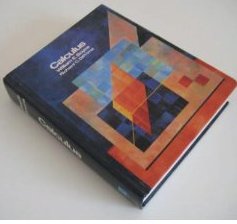
This book presents all the topics which are normally taught in an introductory calculus course~: functions, limits, derivative, quadratic curves, integral, differential equations, series, vector calculus, functions of several variables, line and surface integrals. These topics and their applications are distributed over 18 chapters of this voluminous and luxurious book. The pages, a bit wider than usual (19 cm) allow for a wide margin for the regular text body. However the many exercises included are printed in a two-column format to fill the full width of the page. Similarly, the omnipresent figures are sometimes wider than the text or are simply placed in the margin. Another thing that jumps to the eye at a first glance is the use of blue as well as black printing. Numbering and titles are printed in blue. Also theorems are printed on a blue background. Figures are mostly in black and blue. Pictures of three dimensional objects are made in a suggestive shaded gray.
The previously described impression of the general appearance of the book will already suggest what the contents may be like. Everything possible is done to make mathematics easy-looking and attractive even for the non-mathematician. It will then not be a surprise to find that the authors have tried to feed ``utilitarian mathematics'' to the reader. By this we mean that they do not teach mathematics for the beauty of mathematics but for its use in many practical applications. If a choice between several definitions was possible, the most practically useful one is chosen, rather than the most general one. The proofs of theorems are only given in as far as they are instructive. Many are omitted because they are ``too difficult'' for the students at the level of the material treated. Some proofs can be found as exercises. Counterexamples are also an often used tool in this book to illustrate the necessity of certain conditions. Also many worked examples illustrate what has been instructed. Examples are taken from a broad spectrum of applications but the ones from mechanics and physics are most prominently present. It is a book about methods and applications of calculus, rather than about the theory of calculus.
In this vein of applicable thinking some side results on numerical methods are included. One finds Newton's method, trapezoidal and Simpson's rule for integration and Runge-Kutta methods for differential equations. If the numerical methods are not given explicitly, it is still underlying the material given and the way it is presented (e.g., emphasis on estimation of errors or remainders etc.).
In an appendix, answers to the odd-numbered exercises are given. We should mention that there exists a separate ``Solution manual'' for students giving the full solutions of the problems (and not only the answers). Also an ``Instructor's manual'' can be bought which contains answers and solutions to all problems.
Since the book is intended to be self contained only few references are given. There are however a number of historical footnotes at various points.
Both authors were at the Rensselaer Polytechnic. The second author died in 1984 when most of the manuscript was finished.
To conclude we may call this a practical guide to calculus. The treatment is not theoretical or deep but emphasis is on usefulness and applicability. There is probably too much material to be treated in only one course. The instructor can however choose between the chapters or leave the second half of certain chapters since as a rule, the most important things are treated first. This is an introduction to calculus mainly for the non-mathematician interested in the applications. Typically a textbook to be used in a first years course at a technical university.
Reviewer: A. Bultheel (KU Leuven)
January 23, 2013