|
Author(s): Friedrich Tölke
title: Praktische Funktionenlehre, vol. 1-6 Publisher: Springer Verlag Pages: Year: 1966-1969 Short description: Bull. BMS: ♠ MSC main category: MSC category: |
|
Review:
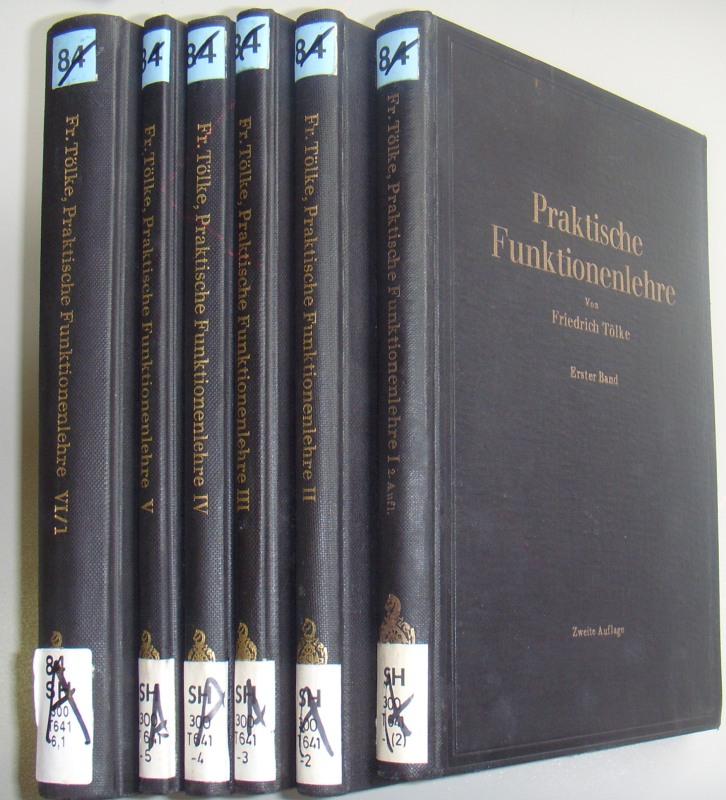
This series of books with formulas, tables, graphs, etc. consists of three large parts. Part I consists of volume 1 only. This is not available to the reviewer but the introduction to the other volumes says that it contains 440 pages on elementary transcendental functions. Part II consists of volumes 2-5 and contains an overwhelming lot of information in the form of formulas and graphs on the subjects that were explicitly mentioned in the titles. The numerical information given is graphical while part III, which consists of the two parts of volume 6, contains tables of numerical values.
This series seems to be a bit less popular than comparable projects like Gradstein and Ryzhik, Erdelyi et al., or Oberhettinger and several others. There may be several reasons for this like being concentrating on a rather restricted and specialized subject. It is also a quite extensive treatment and luxurious edition and hence not a cheap one to spend on such a rather narrow subject. As far as the numerical values are concerned, quality software will nowadays replace extensive tables. Also the fact that it is written in German can be a handicap.
The books provide indisputably an almost inexhaustible source of information for the specialist. Although good numerical software becomes available to compute special functions, a work like this has still a wide readership because of the many formulas that it contains. Maybe the word ``reader-ship'' is not the correct word because you don't ``read'' the books like you would read a textbook, you rather ``consult'' them.
We should especially mention the technical quality of the realization. The books are quite large (20 cm x 27.5 cm) and are printed in a tradition of German quality that you can't find nowadays anymore. The many graphics and the pages full of formulas are of such a striking precision and witness of such a typesetting skill, that you can not but admit to admire it. Even with modern computerized typesetting tools, the production of such books would be a tremendous job.
Reviewer: A. Bultheel (KU Leuven)
January 23, 2013