|
Author(s): H.J.J. te Riele
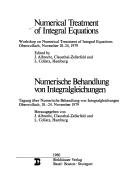
title: Colloquium numerical treatment of integral equations Series: MC Syllabus, vol 41 Publisher: Mathematisch Centrum Pages: vii+259 Year: 1979 Author(s): J. Albrecht, L. Collatz (eds.) title: Numerical treatment of integral equations Series: International Series of Numerical Mathematics, vol 53 Publisher: Birkhäuser Verlag Pages: v+275 Year: 1980 Short description: Bull. BMS: ♠ MSC main category: 45 MSC category: 45-02 |
|

Review:
Some ten years ago, the numerical solution of integral equations was a rather popular subject. This fact is illustrated by the two compilations of papers that are under review. The first one contains eleven papers of lectures held at the mathematical Centre in Amsterdam during the period 1978-1979. The second one contains eighteen papers from the Oberwolfach meeting in November 1979.
The problem with numerical methods for integral equations and related equations is that they are usually designed for a special problem in a particular application area and often lack the generality to be applicable to a wide class of integral equations. Of course there are some general principles that can be formulated for Fredholm or Volterra equations of first or second kind but besides that, special purpose techniques still have a reason of existence. The distinction between those two type of methods is clearly given in the MC Syllabus. It has five papers in the first part on general numerical methods and six papers on applications in a second part. The first part has a general survey of numerical techniques by H. te Riele. Two papers (by te Riele and Cuppen) on Fredholm equations of the first kind and multi-grid methods for Fredholm equations of the second kind are discussed by Schippers. Invariant embedding methods are treated in a contribution by de Vries. Volterra equations are not treated here because three other lectures of which two were about Volterra equations were published as journal articles and therefore not included in this compilation. The six papers in the application area treat problems from semi-conductor physics, population dynamics, fluid mechanics (airfoil analysis and design, diffraction of water waves, subsonic lifting surface theory) and electromagnetic scattering. The lifting surface paper is in Dutch all the others are in English.
The Oberwolfach proceedings have the same mixture of papers on applications and general techniques. Four papers are in German, the other fourteen are in English. The types of problems covered are more diverse. They include Fredholm equations of first and second kind, ill posed problems, integro-differential equations and bifurcation. The numerical methods and the theory that is involved in these contributions include: Runge-Kutta methods, kernel approximations, fixed point theorems, iterative methods, bounds for eigenvalues, finite elements, quadrature and interval analysis. The applications are found in pharma-kinetics, solid state physics, fluid dynamics, etc.
The fact that the first compilation stems from a series of lectures over a longer period whereas the second compilation are the proceedings of a one week conference is reflected in the general impression one gets when reading these papers. The Amsterdam papers are longer in general, have a more tutorial nature and are of a more homogeneous character. The Oberwolfach papers are shorter and more diverse. Applications, numerical techniques, theoretical results, they all show up in different papers and in different situations which are typical research papers.
As long as there is not a comprehensive textbook on the numerical solution of integral equations, this type of proceedings and journal articles will be the only source where one can learn about them.
Reviewer: A. Bultheel (KU Leuven)
January 23, 2013