|
Author(s): Einar Hille
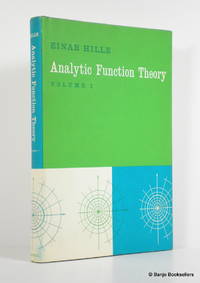
title: Analytic Function Theory, vol. 1 Series: Introductions to Higher Mathematics Publisher: Ginn and Company Pages: xi+308 Year: 1959 Short description: A self-contained introduction to mathematical analysis course at a university level. It actually serves as an introduction to volume 2. Bull. BMS: ♠ MSC main category: 30 MSC category: 30-01 |
|
Review:
This book appears as a volume in a series Introductions to higher Mathematics with editorial board G. Birkhoff, M. Kac and J. Kemeny. Its purpose is to bring ``expository texts designed for use in upper undergraduate courses and in the early years of graduate study''. The present volume is meant as an introduction to the second volume which is twice as thick as the present one. Since, according to the series policy, the whole should be undergraduate level, it is understandable that this first volume is at certain places kept at a very low level. The second volume is more advanced and deals e.g., thoroughly with logarithmic capacity and holomorphic mappings.
After a preliminary study of number systems (real and complex), the geometry of the complex plane is developed and simple functions such as fractions, powers and roots are studied. The main theory begins in chapter 4 with the definition of holomorphic functions, the Cauchy-Riemann equations and the elements of conformal mapping. This is followed by a chapter on power series and one on elementary transcendental functions. The systematic study of holomorphic functions occupies the last three chapters, devoted to complex integration, representation theorems and the calculus of residues. Supplementary material on point sets, polygons and Riemann and Riemann-Stieltjes integration is to be found in three appendices. There is a brief bibliography at the end of the volume and suggestions for further reading are appended to the various chapters. An explanation of the symbols used precedes chapter 1. Each section is followed by a number of exercises.
Most pleasant are the many footnotes in which some historical remarks about the lives of many mathematicians can be found. These notes go further than just bibliographical information or the life span. To give an example of this: on page 24 where we find de Moivre's formula we can read: ``Abraham de Moivre (1667-1754), of a French Huguenot family, settled in London in 1685 after the revocation of the Edict of Nantes. He lived on private lessons in mathematics and games of chance. He was one of the founders of the theory of probability''. The motivation for these many historical notes given by the author is that he wants the students to realize that mathematics is a living organism, a growing body of learning, fed by the efforts of many workers who were once real persons and who built up bit by bit the current structure. I found these remarks most entertaining and for those who are teaching complex analysis, this may be a source for many anecdotes he can use in the lessons. On the other hand, it is unfortunate that there is such a big leap from the first section (the real number system) to the final objective: analytic function theory. For students in 1989, these introductory sections will seem a waist.
Reviewer: A. Bultheel (KU Leuven)
February 17, 2013